Written/Reviewed by:
Last Updated: October 28, 2026
Reading time: Est 9 minutes
Are you looking for a family lawyer in San Jose, CA?
At Schank Family Law, we provide trusted family law counsel for individuals and parents throughout San Jose.
If you are starting a divorce or custody case in San Jose, the orders made in the first few months often set the terms your family will live with for years. Those early orders cover the children’s schedule and the household’s finances.
Schank Family Law has handled family law matters since Christian Schank founded the firm in 2003, and we serve Santa Clara County through an office in San Jose. Our San Jose, CA family lawyer represents either spouse or parent, whether you filed the case or are responding to it. Request a free case evaluation to get started.
A family lawyer represents people in legal matters involving marriage, children, and household finances. That includes divorce and legal separation, custody and visitation, child and spousal support, property division, restraining orders, and guardianships. The work combines courtroom advocacy with negotiation, because most family cases settle through agreements that the court then adopts as orders. A family lawyer also helps clients after judgment, when orders need to be enforced or modified because circumstances have changed.
San Jose households average 2.97 people, according to Census QuickFacts for 2020 through 2024. Many of those households include children, which is why custody and support are often central to a local family law case.
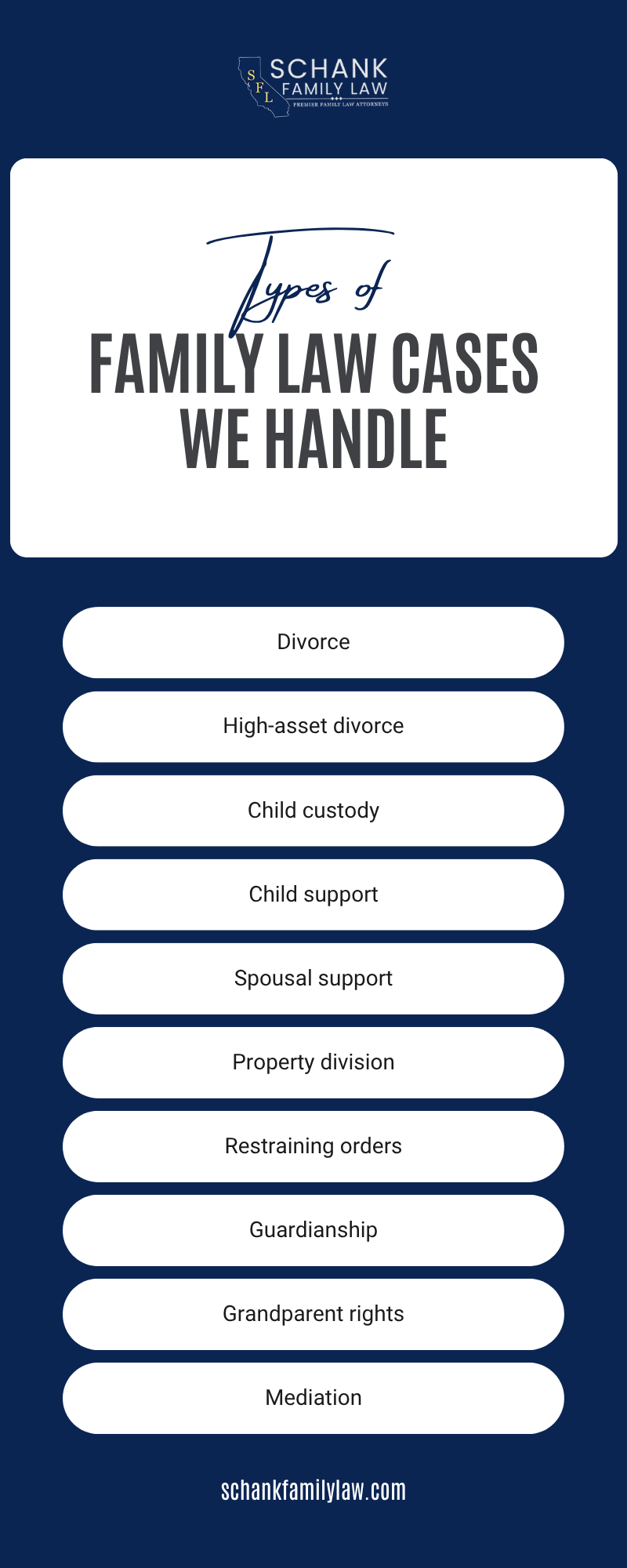
Family law cases rarely involve a single issue. A divorce often includes custody, support, and property questions at once, and our attorneys handle each of the following matters for San Jose clients.
Divorce and legal separation. We represent spouses in contested and uncontested divorces, including high net worth divorces with complex assets, as well as legal separations that divide property and set support without ending the marriage. Each case begins with a review of finances, children’s needs, and the client’s goals.
Child custody. Parents may share legal and physical custody or one parent may hold primary responsibility. We prepare parenting plans and present evidence of each parent’s involvement when agreement is not possible. Move-away requests and holiday schedules are handled the same way.
Child support. Support is set using a statewide guideline that considers income and parenting time. We make sure income is calculated accurately and pursue modifications when circumstances change.
Spousal support. Temporary support may be ordered while the case is pending, and long-term support may follow at judgment. We represent both the spouse requesting support and the spouse asked to pay it.
Property division. Community property is generally divided equally, while separate property stays with its owner. We identify, value, and trace assets so the division is accurate.
Fathers’ rights. Fathers have the same legal standing as mothers in custody and support matters. We help fathers establish parentage and secure meaningful parenting time.
Restraining orders. We represent people requesting domestic violence restraining orders and people responding to them. These cases move quickly, often with a hearing set within weeks of filing. Temporary orders can also affect custody and housing until the hearing.
Guardianship. When parents cannot care for a minor child, a relative or other adult may need court authority to do so. We handle guardianships of minors but do not take conservatorship cases. These cases are often filed when a parent cannot provide a stable home.
Grandparent rights. Grandparents can request visitation in limited circumstances. We evaluate whether the legal requirements are met before a petition is filed.
Same-sex divorce. Same-sex spouses and registered domestic partners follow the same legal process as other couples, though relationship dates and parentage can raise added questions. We address those issues directly.

Our attorneys have handled family law cases from negotiated settlements to contested trials. The firm’s results include a contempt jury trial that produced 95 counts of contempt for violations of custody orders, a successful defense in a serious domestic violence trial, and a negotiated custody, visitation, and child support resolution in a case involving MLB and NFL players. In spousal support matters, the firm has obtained a temporary award of more than $60,000 per month and $22,000 per month for the wife of a prominent trucking company owner. Those results span negotiated agreements, contested hearings, and jury trial work.
Christian Schank began his career managing California’s largest criminal defense firm before moving exclusively into family law. He was admitted to the State Bar of California in 2003, the same year he founded the firm. Today, Schank Family Law handles family law matters only, and San Jose clients work with attorneys based at our local office. Our attorneys represent mothers, fathers, spouses, and grandparents in Santa Clara County family court.
The divorce process follows a defined sequence, and related custody and support issues move through the same case.
One spouse files a petition and serves it on the other, who then has a set time to respond.
Either party may request temporary orders for custody, visitation, or support while the case is pending.
Both spouses exchange financial disclosures listing income, assets, and debts.
Parents with a custody dispute attend mediation, and the parties negotiate the remaining issues.
Any unresolved issues go to trial, and the court enters a final judgment.
A divorce cannot become final until a mandatory waiting period has passed, and temporary custody and support orders remain in effect until the court replaces them with final orders. Legal separation follows similar steps without that waiting period, and some couples weigh contested versus uncontested paths before filing. Couples with no children, limited property, and no spousal support claims may qualify for a simpler summary dissolution.
Children’s interests come first in every custody decision. Judges focus on the child’s health, safety, and welfare, along with each parent’s history of involvement. Courts treat physical and legal custody as separate decisions, so a parent may share decision-making authority even when the children live primarily with the other parent.
The schedule and support amounts set early in a case often influence the final judgment, so the first hearing deserves full preparation rather than a quick filing.
Parentage must be established before custody and support orders can be made for unmarried parents. Fathers who were not married to the mother can establish paternity through a voluntary declaration or a court case.
Social media posts, missed exchanges, and disputes in front of the children can all become evidence, and avoiding common divorce mistakes protects your credibility with the court.
Financial disclosure applies in every divorce, even when the couple has few assets, and a judgment cannot be entered until it is complete.
The right documents depend on the issues in your case, but income records and any existing court orders are useful in nearly every matter.
Any existing court orders, petitions, or responses
Recent pay stubs and tax returns for both spouses, if available
Statements for bank, retirement, and investment accounts
A calendar showing the children’s current schedule and each parent’s time
Police reports or messages relevant to any safety concerns
At the consultation, we review your documents, explain how the law applies to your situation, and outline a plan for the next steps. We also discuss whether temporary orders should be requested right away. Bring copies rather than originals, and include any written agreements you and the other parent have already made.
California law sets the framework for every San Jose family case, and the same core principles apply whether the dispute involves property, children, or support.
No-fault divorce. Neither spouse needs to prove wrongdoing to end the marriage.
Community property. Assets and debts acquired during the marriage and before separation are generally divided equally.
Best interest of the child. Custody decisions are based on the child’s best interest, including the child’s health, safety, and relationship with each parent.
Guideline child support. Child support amounts are calculated from each parent’s income and the time each parent spends with the children.
Spousal support factors. Long-term spousal support depends on factors such as the length of the marriage, each spouse’s earning capacity, and the standard of living during the marriage.
San Jose family law cases are heard by the Superior Court of Santa Clara County at the Family Justice Center Courthouse, 201 North First Street. The court’s Family Court Services office on the fifth floor provides child custody mediation, held remotely, to help parents build a parenting plan. Parents must watch an orientation video before their first session. Mediation through Family Court Services is free, though parents may hire a private mediator instead.
Family Court Services also conducts emergency screening investigations when a judge refers a case involving urgent child safety concerns. Those investigations are limited in scope and focus only on immediate risks to the children, while the broader custody case continues in the family court.
A San Jose family lawyer from our firm can help you protect your children, your finances, and your future. Your first step is a free case evaluation with an intake specialist, who will review your situation and determine whether an attorney consultation is the right next step. Have any court papers you have already received nearby when we speak. Contact us to request yours.
Speak with an experienced attorney about your family law case.
"*" indicates required fields
Attorney Christian L. Schank founded Schank Family Law in 2003. With eight offices and a Certified Family Law Specialist on staff, the firm handles divorce, custody, support, and property matters in courts across the state.
Contact our office to schedule a free case evaluation. Tell us about your family law matter and learn how our attorneys can help.
"*" indicates required fields