Introducing the Schank Family Law Divorce Course — a free, attorney-built guide to navigating divorce in California. Click here to sign up!
![]()
387 reviews
Written/Reviewed by:
Last Updated: September 23, 2026
Reading time: Est 17 minutes

Divorce changes everything about your financial life. If you’ve spent years building wealth with your spouse, figuring out who gets what becomes one of the biggest decisions you’ll face.
Our San Jose, CA property division lawyer handles these issues daily. Schank Family Law has worked on asset division matters throughout Santa Clara County for over 20 years. We understand what’s at stake. Your financial security after divorce depends on getting this right.

Christian L. Schank opened this firm in 2003 with a singular mission: practice family law exclusively. That commitment has shaped everything about how we operate. Christian earned his J.D. from the University of La Verne College of Law after completing undergraduate studies at Brigham Young University. Martindale-Hubbell awarded him an AV Rating in 2000, their highest designation for professional excellence and ethical standards. He also holds Lead Counsel Verified status for family law.
Our Santa Clara County location puts us in the middle of tech industry wealth. Stock compensation packages show up in most divorces we handle. RSUs, incentive stock options, employee stock purchase plans. We’ve analyzed thousands of equity grants across two decades. That experience translates into faster case assessment and stronger outcomes.
Our family lawyer in San Jose, CA practice extends across every aspect of asset division, from straightforward cases to multi-million dollar estates requiring forensic accountants and business valuation specialists.
Not everyone plays fair during divorce. Our attorneys have prosecuted contempt actions resulting in 95 separate counts against spouses who tried to obstruct the discovery process and conceal what they owned.
Property division involves concepts most people encounter for the first time during their divorce. We translate these concepts into language that actually makes sense. Clients who understand their options make smarter decisions about settlements and litigation strategy. That understanding starts in our first meeting and continues throughout your case.

⭐⭐⭐⭐⭐
“My family attorney and the staff from this law firm were the absolute best in helping me. I always felt totally attended to, important and supported. They made me feel so comfortable during a very difficult time. I highly recommend their services and I cannot praise their professionalism enough.” — Cole Connel
Read more reviews on our Google Business Profile.

Assets accumulated in Silicon Valley often require special treatment, and our practice covers the full spectrum of property division cases.

The statutory framework governs every divorce in the state. Understanding these rules helps set realistic expectations.
Family Code Section 760 establishes the starting point. Property acquired during marriage presumptively belongs to both spouses equally. Wages, bonuses, commissions, stock grants, business income, and retirement contributions are all considered community property.
This presumption applies regardless of whose name appears on the account or title. A brokerage account held solely in one spouse’s name still belongs to the community if funded with marital earnings.
Family Code Section 2550 mandates equal division. Each spouse receives assets totaling half the community estate’s net value.
Equal division does not require selling everything and splitting the proceeds. Courts routinely award entire assets to one spouse while offsetting with other property. The family home might go to one party while retirement accounts of equivalent value go to the other. Structuring these trades requires attention to liquidity, tax consequences, and each party’s post-divorce needs.
What you owned before marriage stays yours. Inheritances directed specifically to one spouse remain separate. Gifts from third parties to one spouse alone keep their separate character.
The trouble starts when separate and community assets mix. Deposit an inheritance into a joint account used for household expenses, and tracing becomes necessary to identify what remains. Pay down a premarital mortgage with community earnings, and the community acquires an interest in that property. These situations require forensic analysis to unwind.
California imposes obligations of good faith regarding community assets. Family Code Section 1100 requires honest management. Family Code Section 1101 creates remedies for breach.
Hide an account? Transfer property without consent? Drain community funds on gambling or an affair? Courts can award the innocent spouse 50% to 100% of the asset’s value as compensation. Financial disclosure requirements exist precisely to prevent this misconduct.
The California Courts website offers general information about property and debt division procedures.

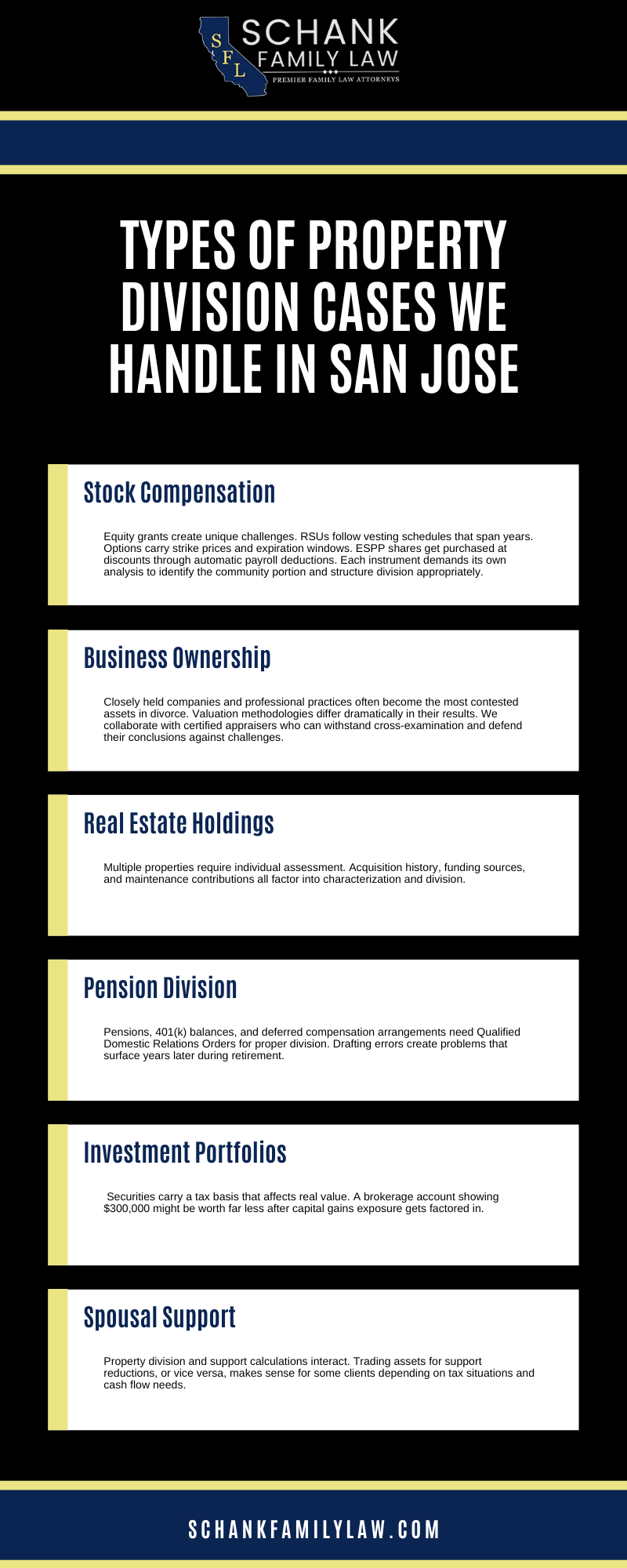
Stock-based pay creates analytical challenges that don’t exist with ordinary salary.
RSU grants typically vest over four years. A grant awarded before marriage with vesting continuing afterward contains both separate and community portions. California courts apply allocation formulas, but selecting the appropriate formula depends on grant terms and employment circumstances.
ESPP shares get purchased at discounts through payroll withholding. Shares bought during marriage belong to the community. But tracking multiple purchase lots at different prices over years of employment requires meticulous record review.
When a spouse owns a company, disputes over its worth can consume the entire case.
Appraisers employ competing methodologies. Income approaches capitalize projected earnings. Market approaches benchmark against comparable sales. Asset approaches inventory tangible holdings. Each method yields different numbers.
Goodwill complicates matters further. Enterprise goodwill attaches to the business itself and qualifies as community property. Personal goodwill reflects an individual owner’s reputation and relationships. California excludes personal goodwill from division. For professional practices and owner-dependent businesses, drawing this line determines whether the community stake is $500,000 or $2 million.
We work with valuation professionals who understand these distinctions and can defend their conclusions under adversarial conditions.
Earnings after separation belong solely to the earner. For high-income spouses, the separation date can shift property division by substantial amounts.
California defines separation as a complete break evidenced by expressed intent and consistent conduct. Physical separation alone isn’t enough if spouses continue sharing finances, filing joint taxes, or holding themselves out as married publicly.
Disputes over separation dates arise frequently. Email exchanges, text messages, and social media activity often provide evidence supporting or refuting claimed dates.
Asset transfers between divorcing spouses don’t trigger immediate taxation. But the receiving spouse inherits the original tax basis.
Consider two scenarios. Spouse A receives $400,000 in cash. Spouse B receives stock worth $400,000 with a $100,000 basis. On paper, equal division. In reality, Spouse B faces $300,000 in built-in gains that will eventually be taxed at capital gains rates.
Sophisticated property division accounts for these differences. We analyze after-tax values when evaluating proposals and structuring agreements.
Understanding how community property works provides essential context for making these decisions.
Spouses sometimes attempt concealment. Unreported accounts. Undervalued business interests. Cryptocurrency holdings. Deferred compensation arrangements buried in employment agreements.
Family Code Section 2100 mandates full disclosure of all assets and liabilities. When we suspect concealment, forensic accountants, subpoenas, and aggressive discovery uncover what’s been hidden. The penalties for non-disclosure often exceed the value of whatever someone tried to hide.
Property division in Santa Clara County divorces carries consequences that last for decades. Complex assets demand attorneys who recognize their characteristics and understand California’s treatment of each one. Schank Family Law offers free consultations. We’ll assess your circumstances, walk through the division process, and provide an honest perspective on your situation. Family law remains our only practice area. Contact us today to schedule your case evaluation.

1. Create a complete inventory of every asset acquired during the marriage. List real estate, vehicles, bank accounts, investment accounts, retirement plans, stock options, RSUs, cryptocurrency, business interests, and personal property of significant value.
2. Identify which assets are separate property. Anything owned before the marriage, received as a gift, or inherited during the marriage is generally separate property under California law. Gather documentation proving the acquisition date and source.
3. Pull title documents for all real estate. Deeds, mortgage statements, and refinancing records establish ownership history. If separate property funds were used for a down payment on a home purchased during the marriage, you need records proving that.
4. Collect statements for all financial accounts. Bank accounts, brokerage accounts, 401(k)s, IRAs, pension statements, deferred compensation plans, and stock plan accounts should all be documented with statements from the date of marriage through the present.
5. Obtain a current valuation of any business interests. If either spouse owns a business or holds a partnership interest, a formal business valuation may be necessary. The community’s interest in the business depends on when it was started and how it grew.
6. Document all debts and liabilities. Mortgages, car loans, credit card balances, student loans, and tax obligations all get divided alongside assets. Knowing the full debt picture prevents surprises.
7. Trace any commingled funds. When separate property gets mixed with community property, tracing establishes what portion belongs to each category. Bank records going back to the beginning of the marriage may be necessary.
8. Gather RSU and stock option grant agreements. In Silicon Valley divorces, equity compensation often represents the most valuable and most complicated asset to divide. Grant dates, vesting schedules, and exercise prices all matter.
9. Complete your preliminary declaration of disclosure. California law requires both spouses to exchange financial disclosures early in the case. Incomplete or inaccurate disclosures can result in sanctions.
10. Consult with a property division attorney before agreeing to anything. Informal agreements made before you understand the full asset picture can cost you significantly. Get the analysis done first.


Property division in Santa Clara County involves asset values that dwarf most other California jurisdictions. The U.S. Census Bureau reports median home values in San Jose exceeding $1.1 million, and many homes in neighborhoods like Willow Glen, Almaden Valley, and Los Gatos sell for considerably more. For couples who purchased a home during the marriage, the equity in that single asset can exceed $500,000 or $1 million depending on when they bought and where.
Real estate is only part of it. Silicon Valley compensation packages routinely include RSUs, stock options, ESPPs, and deferred compensation that can be worth hundreds of thousands of dollars. According to Judicial Council data, family law cases represent one of the highest-volume categories in Santa Clara County Superior Court, and the complexity of asset division in this region contributes to longer case timelines compared to counties where the primary assets are a house and a retirement account.
Retirement assets add another layer. A 401(k) balance of $500,000 or more is common among mid-career tech professionals. Pension benefits from employers like the county government, school districts, or federal agencies require specialized division through qualified domestic relations orders. The Department of Labor provides guidance on QDRO requirements, which differ depending on the type of retirement plan involved.
California’s community property system requires equal division of all assets acquired during the marriage. Under Family Code Section 2550, the court must divide community property equally unless both parties agree to an unequal split. Equal does not always mean selling everything and splitting the proceeds. Often one spouse keeps the house and the other takes a larger share of retirement accounts or stock, with equalizing payments to balance the ledger.
The date of separation matters enormously here because it determines which assets are community property and which are separate. Stock grants that vest after separation but were awarded during the marriage require time-based formulas to allocate the community and separate portions.

Yes. California is a community property state, which means assets acquired during the marriage belong equally to both spouses and must be divided equally at divorce. Separate property stays with the spouse who owns it.
Generally, anything earned or acquired by either spouse from the date of marriage through the date of separation. Wages, bonuses, stock vests, real estate purchased with marital funds, retirement contributions, and business growth all qualify.
The most common options are selling the home and splitting proceeds, one spouse buying out the other’s interest, or deferred sale arrangements when minor children are involved. With San Jose home values often exceeding $1 million, the buyout math requires careful analysis.
Unvested stock awarded during the marriage is typically divided using a time-based allocation formula. The formula accounts for the portion of the vesting period that occurred during the marriage versus after separation.
You can, but your spouse is entitled to their community property share. Division typically happens through a QDRO for employer plans or by offsetting the retirement account value against other assets.
California law imposes a fiduciary duty on both spouses to fully disclose all assets and debts. Under Family Code Section 1101, sanctions for hiding assets can include awarding the entire hidden asset to the other spouse.
Business valuation methods vary depending on the type of business. Common approaches include asset-based valuation, income-based valuation, and market comparison. A forensic accountant or business appraiser typically performs the analysis.
Not for community property purposes. If an asset was acquired during the marriage with community funds, it belongs to both spouses equally regardless of whose name appears on the title or account.
Crypto acquired during the marriage is community property. The volatile nature of cryptocurrency creates valuation challenges because the value on the date of division may differ significantly from the value at trial or settlement.
Community debts get divided equally, just like assets. Mortgages, car loans, credit cards used during the marriage, and tax obligations incurred on joint returns are all subject to division.
Yes. Spouses can agree to divide property however they choose through negotiated settlement. Courts only impose equal division when the parties cannot agree.
The date of separation is when one spouse communicates to the other that the marriage is over and takes actions consistent with that decision. Everything earned or acquired after that date is separate property. In Silicon Valley, where stock vests monthly or quarterly, even a few weeks’ difference can shift tens of thousands of dollars between community and separate categories.
Simple cases with straightforward assets can resolve in a few months. Complex cases involving business valuations, tracing claims, multiple real estate holdings, or disputed stock compensation can take a year or longer.
Cases involving business ownership, suspected hidden assets, complex tracing, or self-employment income often benefit from forensic accounting. The cost of the analysis usually pays for itself by uncovering assets or income that would otherwise go unaccounted for.
Fees depend on complexity. Cases involving a house and retirement accounts cost less than cases involving business valuations, stock option analysis, and tracing claims across decades of commingled accounts. Schank Family Law uses a retainer structure with hourly billing.

Property division in Santa Clara County begins with both spouses exchanging preliminary declarations of disclosure. These documents require each party to list every asset and debt, along with current values and characterization as community or separate property.
If the parties agree on values and division, they can submit a marital settlement agreement to the court for approval. Most cases involve some negotiation to reach this point, and many resolve through mediation rather than trial.
Contested cases require more extensive preparation. Appraisals of real estate, business valuations, actuarial calculations for pension benefits, and forensic tracing of commingled assets may all be necessary. If the parties cannot agree, the judge conducts a trial and divides the community estate equally based on the evidence presented.
Several factors influence how long the process takes in this county: the number and complexity of assets, whether either spouse disputes characterization or valuation, whether business interests require formal appraisal, and how cooperative both parties are with disclosure obligations.

Several agencies and organizations in Santa Clara County handle matters that intersect with property division proceedings.
Schank Family Law is not affiliated with and does not endorse any of the organizations listed above. This information is provided for reference purposes only.
111 N Market St #1020
San Jose, CA 95113
Property division disputes in San Jose involve real estate values, stock compensation, and retirement assets that can total well into the millions. Getting the characterization, valuation, and division right on these assets requires attorneys who handle Silicon Valley divorces regularly and understand how to analyze equity compensation, trace commingled funds, and present complex financial evidence to Santa Clara County judges. Schank Family Law has handled property division cases across this county for more than 20 years.
Contact us to schedule a case evaluation. We will review your asset picture, explain how California’s community property rules apply, and give you a clear assessment of your options.
Posted on GoogleLeann C
Highly recommend. Amazing and supportive during a challenging divorce. They understand woman’s rights. The team explains the steps being taken. They know how to handle a spouse that is uncooperative.Posted on GoogleRaime G
Mr.Schank did a wonderful job for our case, I can’t thank him enough! The entire team is so helpful, professional and friendly! I highly recommend their services! Thanks again! 🙌🏼Posted on GoogleRobert M
I cannot thank Schank Family Law and my attorney, Vanessa Estrada, enough for everything they did for me and my daughter. After a long and difficult custody battle, we achieved a successful outcome, and I truly believe Vanessa’s dedication, knowledge, and hard work played a major role in that victory. From day one, Vanessa genuinely cared about my case. She took the time to understand every detail, remembered every situation, and always made me feel like my case mattered. Her professionalism, preparation, and knowledge of family law gave me confidence throughout one of the most stressful times of my life. What impressed me most was how hard she fought. She never gave up, stayed focused on what was in my child’s best interest, and stood by me every step of the way. Whenever I had questions or concerns, she was responsive, honest, and always prepared. If you’re looking for an attorney who truly cares about her clients, is extremely knowledgeable, and will fight for you until the very end, I highly recommend Vanessa Estrada and Schank Family Law. Thank you, Vanessa, for helping me secure a better future for my daughter and for being such a strong advocate during this journey. I will always be grateful. ❤️Posted on GoogleAsh M
I had a awesome phone call with Clarisa she settled me made me feel a lot better took the time to hear me out.. extremely happy I made the appointment with her..Posted on GoogleVivian S
I’m so grateful for Shank Family Law. Christian Schank and Derek Austin helped me so much during an extremely stressful time, and I truly felt like I could fully rely on their knowledge and expertise. Brian in the office was also always so kind and lovely to speak with. Their whole team made me feel supported and taken care of, and honestly helped me sleep better at night knowing I was in good hands. I would never go with anyone else.Posted on GoogleCollin w
Shank Family Law was absolutely amazing. Everyone from the attorneys to the staff and secretary was compassionate, professional, and incredibly knowledgeable. They provided so much guidance and support throughout the entire process and truly made me feel cared for during a difficult time. I honestly could not imagine choosing anyone else. I’m beyond grateful for their help and highly recommend them.Posted on GoogleCooper C
Helped me so muchPosted on GoogleBeverly A
Great Family Lawyers! They really care about their clients and have great communication. I would recommend!Posted on GoogleLuke H
Working with Christian Schank was one of the best decisions I could have made during a really difficult time. They are truly the best in the state. Incredibly knowledgeable, always responsive, and they went above and beyond to protect my interests. I felt supported and confident every step of the way, and everything was handled with professionalism and care. I could not recommend them more highly.Posted on GoogleRuff F
Great firm, they are legit in family law cases
Speak with an experienced attorney about your family law case.
"*" indicates required fields
Attorney Christian L. Schank founded Schank Family Law in 2003. With eight offices and a Certified Family Law Specialist on staff, the firm handles divorce, custody, support, and property matters in courts across the state.
Contact our office to schedule a free case evaluation. Tell us about your family law matter and learn how our attorneys can help.
"*" indicates required fields